
RoPE: Rotary Position Embedding
From first principles, the small mathematical change that unlocked long-context reasoning
When a transformer receives token embeddings, it does not see a sequence. It sees a bag of tokens—a jumbled set of words with no inherent order. The transformer has no idea which word comes before or after another.
So the sentence The quick brown fox jumps over the lazy dog is indistinguishable from brown dog fox jumps lazy over quick the the.
How do we give tokens a sense of position?
The earliest transformers answered this very literally—by adding a position embedding to the token embedding. This came to be known as Absolute Positional Embedding.
token_with_position = token_vector + position_vector
At first glance, this seems reasonable. But consider two sentences:
- Sentence A: The blue sky is bright.
- Sentence B: I love the blue sky.
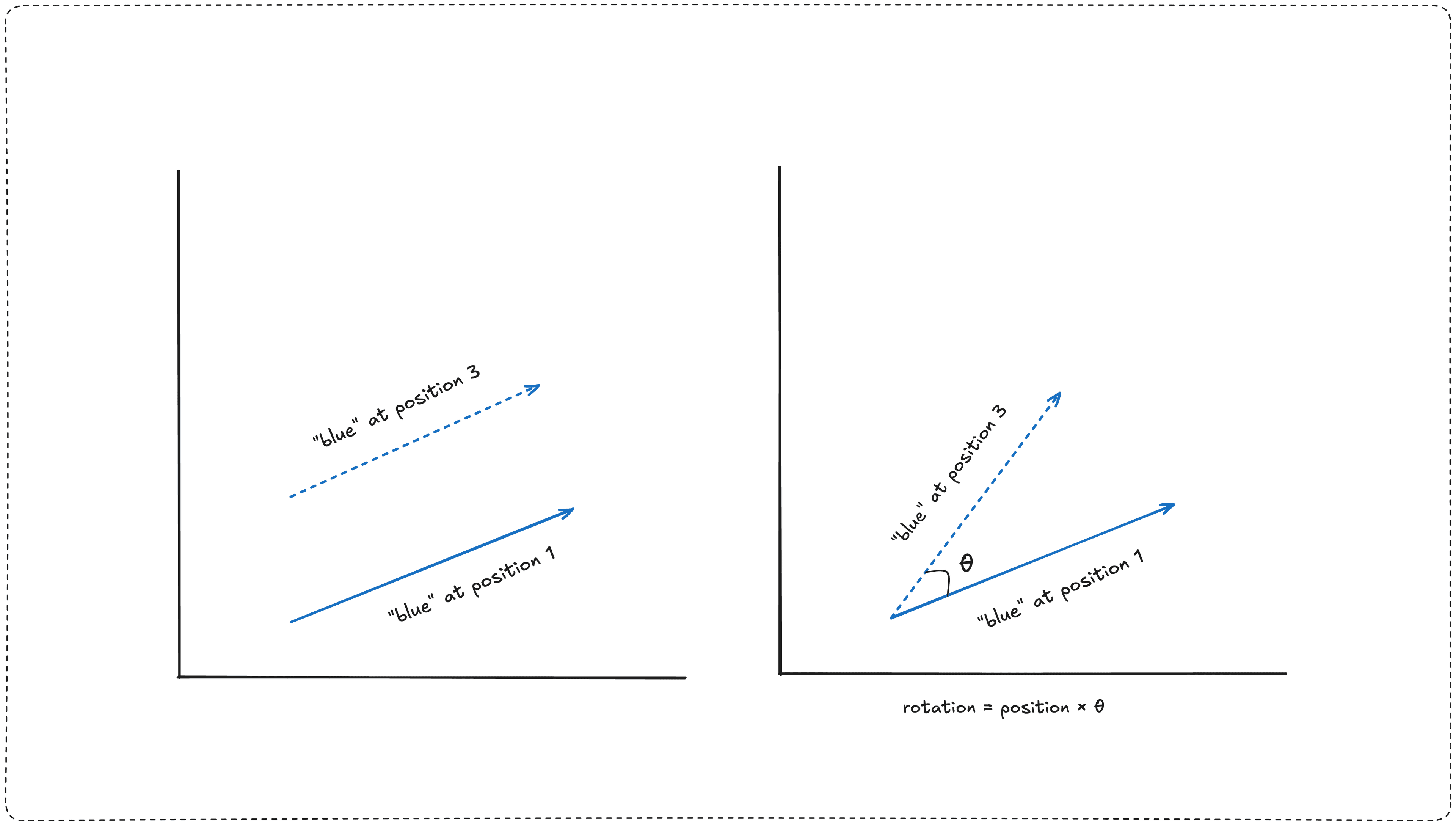
With absolute positional embeddings, the token "blue" is represented as:
- In Sentence A:
embedding(blue) + position(1) - In Sentence B:
embedding(blue) + position(3)
Even though "blue" means the same thing in both sentences, its vector representation is now different—because we added something to it. This means the model must relearn the same relationships across positions.
So how do we encode position into a vector without changing its meaning?
We don't add position to the vector—we rotate it by an angle that represents position. Position of the vector maps directly to rotation:
- position 0 → rotation by 0
- position 1 → rotation by
- position → rotation by
The further the token, the more it is rotated. In other words:
angle = position × base_angle
But how do we rotate a 4096-dimensional vector?
By decomposing it into 2D pairs. A 4096-D vector becomes 2048 independent 2-D vectors. A single large rotation is replaced by many small, pairwise rotations. To rotate a 2D vector , we multiply it by a rotation matrix :
where:
This rotation is applied to every 2D pair in the embedding, using an angle derived from the token's position.
Now we have a way to rotate each part of the embedding based on position. But if all pairs rotate at the same speed, then after a while, distant words can begin to look like nearby ones. The sense of distance is lost. Think of it like a ruler that only has centimeter markings- you can measure small distances precisely, but large distances blur together. A good ruler has millimeters, centimeters, and meters—so you can measure both small and large distances without losing relative scale. RoPE uses the same principle. It assigns a different rotational speed to each pair:
- Early pairs rotate faster, later pairs rotate slower. The rotation angle for the -th pair at position is:
So the entire RoPE algorithm is surprisingly simple:
- Decompose the embedding into 2D pairs
- Assign each pair a rotation frequency (faster for early pairs, slower for later)
- Compute the rotation angle from
- Rotate each pair using a 2D rotation matrix
This is plain trigonometric rotation, not learned weights. This means models can reason with longer sequences than they've ever seen during training.